Thursday, June 13, 2013

"P" and "O" are still for Pisac and Ollyantatambo...


.After lunch at Inkalicious, we headed off towards our next stay, which was in the tongue-twistery named town of Ollantaytambo. Remember that two L's in a word are pronounced as a Y, so it's simple enough to say "oh yan tay tambo", which is the proper way to say it, but for whatever reason, my mind  (and tongue) just couldn't seem to do so. I wanted to say the L's, and it would come out all wrong, like "oh lee LAN Tay ambo" and such. I eventually heard someone say "O-town" and that's what it became.

The drive was beautiful, tall mountains surrounding the lush Sacred Valley, crops of corn and potatoes dotting the landscape as we drove. 

The town itself is like a step back in time. It dates from the 15th century, and has the oldest continuously occupied dwellings in South America. Imagine! Continuously occupied since the time of the Incas.

It's built in a grid formation, with I think 4 main parallel roads that intersect with 7 streets. And in the centre is the main plaza that has a small park in in, surrounded on all 4 sides by little shops and restaurants. It seems like everywhere we went, in Peru, I thought was "my favorite place", but I really think Ollantaytambo was my favorite place.

The streets that branched off of the main plaza were very narrow, and cobblestoned, with high walls and secret looking doors. 
And notice the water rushing down the right side of the picture? That's how the homes get their water to this day. It races through the streets and lanes, and into the homes. Water from Inca aqueducts. Sounds sort of romantic-ish, but I did see dogs standing in it to cool off, no to no doubt have a pee, and there was garbage here and there as well. I'm sure it was a seething mass of germs, but the locals cook with it and drink it with no ill effects. I stuck to bottled water.
This lane had a dry channel. Apparently they block certain sections off for a day, or sometimes just for a few hours, for maintenance and cleaning.
It just seemed so...I don't know, "back in time-ish" to be sitting at a restaurant, and having the water streaming down the middle of the road. I kept wondering how many drunk tourists stumble into these little channels and sprain an ankle as they wander home at night. That's not as touristy-bashing as it sounds, Ollantaytambo is the final stop on the way to Machu Picchu and thus there are a lot of Trekkers who have a day prior to their trek to kick back and relax. 
Another secret looking lane.

I walked and wandered through the streets, just turning left or right as the moment hit me, it would be so easy to get lost if the  place was much bigger, however the streets weren't much more than seven or eight  blocks in any direction, so it was fairly easy to find your way back to where you started from.

I was enthralled by all the doors and what was behind them....from homes to hostels to restaurants and small shops and stores. 

Above: A hostel

Above: Somebody's home.

Above: A cafe.

Above: hmmm...not sure what's in here.

Our hotel was just a couple of minutes walk from the plaza, another cute place.  It was older, and sort of tattered in places, my sheets were clean, but were obviously old as they had some bad thin spots and some torn edges at the corners. My room had a bed, a small night stand and a piece of triangle shaped wood hammered in the corner as a shelf.  You can see the wonderfully luxurious duvet. It sat on top of two incredibly heavy woolen blankets, plus a regular blanket and a sheet. Remember....no central heating in hotels. 
But look at the view!
The Andes!
Even from the bathroom!
Beautiful terra cotta rooftops with the typical Christian cross and Inca symbol.
I was curious as to why every single home that we saw had this same ornament on top. As it turns out, when the Spanish invaded and decided, in all their Christian wisdom to convert everyone, they made sure that every home had a Christian cross on top, to show that they had been converted. However, the Quechua people (because remember? They weren't actually "Incas", they were Quechua with a ruler who was the Inca.) anyhow, they had previously had the bulls on their roofs as a symbol of duality (male and female) and wealth and fertility. Some people say that the bulls were a sign to the gods to ask for protection. Regardless, it became a quirky mixture of Catholicism and Incan tradition.

And speaking of quirky, our hotel, the Inka Gardens, was set up in a very quirky way. There were three sections, shaped like an open square, two stories high, except for the newer part, which was three, but basically it was like  a million other motels around the world, but in this place, none of the sections or stairs  connected with any of the other parts. In other words, to get from my section to someone else's meant going down a flight of stairs, around a corner, up another flight, and usually that still didn't get me where I wanted to be. I'd go down again, circle around the little bar/restaurant in the middle, go up another flight of stairs and find myself somewhere else entirely. It was a constant confusion for me. Maybe it was just me. Everyone else seemed to be able to congregate for a glass of wine, and I was left wandering aimlessly up and down endless flights of stairs. 
Margy, in the orange hat, inviting me for wine. I don't think I ever did find my way to her area. I did manage to get on the little sun deck you can see, it was on top of the tiny bar and breakfast area, it didn't attach to the rest of the hotel at all, there were times when I seriously considered taking a running leap to get to where I wanted to be.

This is a photo of the inside of the motel grounds, looking out, and the picture below this one is from the outside, looking in. I got such a kick out of walking back here in the evening, going through our own little secret door.

Once we got ourselves organized in our rooms, Esther and myself decided to walk to the plaza and see what there was to see. Unfortunately we only walked a short distance when she suddenly felt quite ill and decided to go back to her room. I didn't see her for 2 days...she was very sick with something...flu, water problems, altitude, or a combination of all three. So I continued on my own, exploring the plaza and the back streets as well. 

I went into the market, I was feeling the need for some fresh fruit. I figured bananas and oranges were the best best since both can be peeled and neither needed to be washed. The grapes looked so tasty, but it didn't seem wise to wash them with water that came from the streets....


The veggies looked so huge, I've never seen carrots this size before! And they make a pre -packaged salad too, lots of julienned and diced veggies, all in a bag, ready to eat. As a matter of fact, I noticed a lot of small kids running around with a bag of these, eating them as a snack. What a good idea. And you can see small bags of what I assume is some sort of dressing or marinade as well.

Massive carrots.
All kinds of fruit.

So I bought a banana and decided to go and find the craft market that I heard about, which is not at all the same as the fruit and veggie market. It took me forever to realize that  "the market" and "the market" didn't mean the same thing at all. So, I left the market to wander over to the market, but I got hopelessly turned around and ended up back in an alley.

However....this turned out to be a really good thing because as I woefully peered into doorways, looking for a market, a woman saw me and waved me into her doorway, which turned out to be her home!

It was basically one large room. When you entered her house, the bedroom was to the left. Hanging from the ceiling rafters were dried corn and fish.

I know that those look like bats or something even creepier, but its just dried trout.
There was a small step down, to the right, and this was both her kitchen area, this picture shows her "stove" and you can just see the corner of the table.
And running all over the place, but unable to get up that step, were guinea pigs, or cuy, as they are called here,  I think there was about 40 or 50, including little babies. Sweet Eddy had mentioned earlier that most families had 50 or so guinea pigs in their homes, they raise them to eat. I'm wondering in hindsite if the woman expected me to purchase one.

She waved her arms around, gesturing to the parts of her home, and we smiled at each other and then I went on my way. It was quite unusual. I didn't see any place that could be considered a toilet, although I guess with no running water, they don't really have one. A bucket that they empty now and then? I kept meaning to ask Eddy, but I kept forgetting.

I eventually found my way back to the square, and back to the hotel, just in time to join some folks for dinner. We went back to the plaza, to a place called Papas, where I once again wasn't hungry so I just  had a sandwich, a loma saltado. 


Mmmm....strips of sirloin marinated in soy sauce and spices, then stir fried with onions and peppers. A classic Asian-Peruvian mixture. And the ubiquitous potato.

After we ate, we walked back to the motel, it was dark out, very few street lights exist in these small towns, and so the stars were magnificent, I stopped to gaze upwards and to my pleasure I realized that I was in a new hemisphere and thus the constellations were different! And there was the Southern Cross. I can't tell you what joy that gave me to see. When I was a kid and my parents were teaching me about the stars, the first constellation I learned was of course, The Big Dipper, and I remember being told that kids on the other side of the world couldn't see it, but they saw, instead, The Southern Cross. I was quite jealous, The Southern Cross sounded much more exotic than The Big Dipper, that just sounded like a kitchen utensil. Anyhow, I asked Sweet Eddy, just to make sure, and yup, sure enough, there it was. How lucky that it was a clear night.

I slept like a log in my woolen blanket laden bed....no barking dogs, or at least they didn't bark much, not compared to the carrying on they did in Cusco. Between the the dogs, the partiers, the drunks and the police, it was hard to sleep in Cusco. The dogs here had a bit of a go around for a half an hour or so, and then I guess they must have all gone to bed. Small town life...even for dogs. However....at about 4:30 AM the rooster started, I think he may have had the room beside me. Damn rooster.
My feather duvet and the two heavy blankets. There is seriously no need for heat in these motels.
The pretty lamp in my room. The duality of the sun and the moon is everywhere here.

In the morning, at the breakfast bar, I had my first experience with coffee syrup. That's not what it's called, I think they just call it coffee. I walked in and looked for the coffee pot, or, the Nescafé (of which I was really heartily tired of) and a few of my co-travelers were already there and explained to me how this new form of coffee worked.

You pour a bit, and I mean just a bit, like a tablespoon or so, of this...coffee extract I guess you could call it, in to your mug and then add boiling water, and then your hot, frothy milk (I really did love the hot milk part) It wasn't instant coffee, it was genuine coffee, and not like a condensed coffee, just the extract from the bean, i guess it could be called a concentrate. I think that every "batch" was different, maybe depending on the bean, or the method of extraction...I don't know, all I do know is that it was virtually impossible to figure put a decent mixture...it was either too weak, too strong, too bitter....once....once....I got a perfect mix and it was the best coffee I think I have ever had...but only the once.....usually it was too strong so I just added more and more hot, frothy milk until it was almost a latte, which isn't a bad thing, it's just not what I crave first thing in the morning. But it's ok....it was still caffeine.

However, the next day was all well in my world when I walked past this place:
and saw a woman drinking coffee, and the coffee looked good. I asked her if it was Nescafé and she shook her head and smiled blissfully and said that it was not, that it was the best coffee she'd had in weeks, so went inside and saw this:
And I got one of these:
I can't even tell you how much I enjoyed sitting there, drinking a good coffee, enjoying the view...both the Andes above me and people wandering through the plaza, kids playing in the park, it was just a perfect and peaceful hour. Until a fellow sat at the table beside me, asked me where I was from, and when I said British Columbia, he said "I'm from Colorado...so as long as you're not a Canucks fan, I'll talk to you...I don't ever  talk to Canucks fans." I didn't figure he was serious, but still...rude.

And the funny thing is, I'm not a Canucks fan, I am, as a matter of fact, a Colorado fan....but he screwed any chance of a decent conversation with his opening gambit. Arrogant ass. So I smiled and said "Canucks all the way!" And we finished our coffee in silence....I guess he was serious. But it didn't ruin my day, I actually felt smug and superior to him, I'm not sure why, I just did.

Kids in the park, leaping off the back of the bench and climbing in the tree.
I finished my coffee and wandered through the shops some more. 

Doors within doors.

Colourful walking sticks for sale, but you can't take them up Machu Picchu, to prevent damage tomthebsteps and grounds, only certain types of rubber-tipped sticks are allowed past the gate.


A little pharmacy which ended up being well used as we had a few sick travellers during our time here...luckily they sell electrolytes, antibiotics and upset tummy remedies everywhere.


One side of the plaza.

This afternoons hike was up to the old storehouse/grainery that overlooked Ollantaytambo. Once again, it was quite a hike, but first we walked to the market. That would be the craft market that I couldn't find by myself. It was just behind the plaza, across the bridge and beneath the ruins.


Saturday, June 08, 2013

"O" and "P" are for Ollantaytambo and Pisac, just not in that order.

After leaving the women's weaving cooperative, we wove our way back down the bumpy, windy road and headed towards Pisac. 

The Pisac ruins are some of the largest in the entire Sacred Valley, and dispite the excellent condition that they are in,  not much is known about them. I'll tell you what I know....I know that they made me love to hate Inca steps. Or any steps for that matter. It wasn't a hard hike, but yet it was exactly that....a hard hike.

It only took about two hours, (one way) maybe a bit longer, but let me tell you, if that's any indication of the Inca trail (and guess what? It is an indication of the trail...the guides watch to see how you cope, and that gives them a good idea of how well a person will do on the actual 4 day Inca trail. Aaaaand, I talked to someone after, and they, the guides, were dead on with the ones that they knew would have problems. ) 
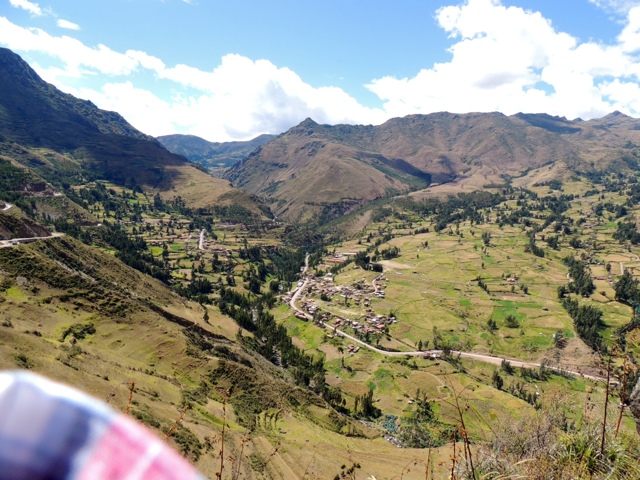
Looking down on the Sacred Valley from about halfway up to Pisac, above picture.

It was a hot day, and I had stocked up on water, between the heat and the altitude, water is a necessary item, too bad it's so heavy. Between a water holder, my camera around my neck, my knapsack on my back (Val-de-ree, Val-de-raaaaa...my knaaaapsack on my baaaack), it was like I wanted to have a temper tantrum from all the straps in my way whenever I wanted something.  I'm sure you can picture it, you know how your hands get all flappy and annoyed when stuff gets in your way and all tangle-y? And you want to snarl "Faaak...stupid shit in my faaking way!" Well, it was worse than that, I just don't do heat or stairs well, and a combo of heat and stairs was really frustrating me.

I was so thankful, however, that I was doing this because I wanted to, not because I was farming these terraces and had to. Sheesh, I'd have made a lousy Inca farmer. I kept imagining myself, being a woman back in the day, having walked to the very top of the terrace and then realizing I had forgotten my lunch at the bottom.  I guess when they swore they didn't say "Jesus Christ!"

Terrace farming is much more interesting than you would think. I mean first of all, imagine the work involved in carving these steps out of the steep mountainside. Each of those "steps" is 10 or 12 feet high. Then, the hauling in of the stones to make the retaining walls, so much work.  And how did they know that the stone walls would heat  up during the day and keep the crops from freezing at night? And they realized that steps like this were the most efficient use of shallow soil and would help prevent soil erosion and run-off. What? Run-off? From what water? Oh, from the canals and aqueducts that they then built, which still have fresh, clean water running through them to this very day.
  I splashed some of the water on my face and neck, but I didn't drink any. We weren't sure where it comes from, and there are llamas and people up here, and you never know who (or what) might pee where, and  where said pee might trickle in to or down to. There are little "fountains" (for lack of a better word) like this one, that just pop up in the middle of nowhere...no one is sure where the spring begins, or how deep it is, or how long the underground aqueducts are, or, more interesting yet, how they built them...talk about a good infrastructure, in my hometown of Cranbrook, our water mains burst somewhere in town at least once or twice a year. And we have technology up the yingyang. How can your mind just not be constantly in a dither here?
This was at the top, near The Temple of the Sun. It just astounds my mind that this water is still flowing...where does it come from? And how did they know?
And by the way, here's an interesting tidbit as to the name "Inca" and what it really means. It doesn't have anything to do with water, but I keep meaning to jot it down and I keep forgetting. 

The word Inca actually meant the ruler of the people, like a king. The people were called the Quechua. There were only a few Inca kings, 12 as a matter of fact, and as one died, a new Inca replaced him, similar to a monarchy. They were chosen by both bloodline and marriage. When the Spanish conquered the Quechua, they called all of the people Inca, to lessen the power of the word, and as the  years went by, the word Inca came to mean all of the people, even though it isn't  correct.


More terraces. And look how HIGH we are! As we walked up here, we passed a large mountain/hill filled with holes, which had been burial sites, but had been vandalized over the years and all the bodies were long gone. 

They buried them this high because they believed it would make it easier for the condor, one of the animals that they worshipped, to find the spirit of the deceased and guide them home. 
There were hundreds and hundreds of holes like this in the mountainside.

There were quite a few trails and paths cross-crossing the one we were on, and apparently a lot of locals use the paths to get to Pisac town, which has a huge market twice a week. I really like this next picture, I'm assuming that this woman was on her way to the town since she wasn't selling anything, she just seemed to be enjoying the view. Hopefully she wasn't looking at her house waaaay down there and realizing she had forgotten something.
And dammit, if we didn't even walk higher:

And I think even a bit higher yet! The scenery was breathtaking. Or that might have been the altitude. I do know that my breath was sometimes in short supply, but luckily there was no rush, no hurry, we could sit and enjoy the scenery...we were actually encouraged to take our time, to walk away and find a spot to just alone to soak in the atmosphere.  I was most appreciative of that, I enjoy being by myself, especially in a place like this where there is just so much to try to comprehend.
If you look in the centre of the picture below, you can see some of the path, and how it winds back and forth. There were huge steps, easy sections, some places that curled through little tunnels and tight spots, a little bit of everything to test ones mettle.
Finally! The top! Time to enjoy the scenery and then we're done....except, what? Now we need to walk back down, and down wasn't all  "down", a lot of the "down" was still back "up". I'm not sure how that happened, just another bit of Peruvian magic I guess....


Our guides tried to cheer us up with guide-like silliness as we trudged down....hungry and tired and hot and sweaty, but for the most part, pretty pleased with what we had accomplished. I know it doesn't seem like much, a hike of a few hours, but it was unlike any hike I've ever done, and I was pretty pleased...both with myself, and with the sights I saw.

I would say that if you are ever in this neck of the woods, make sure you go to Pisac. It was truely impressive.

When we got back to our air conditioned bus, we headed down the road to have some lunch, at the poorly named Inkalicious. I think that's at least the second place we've eaten at with that name, and it's not like it's a chain, it's just a name that restaurant owners around here seem to like, I've noticed it a few other times as well. I kinda get annoyed at this trend of having "licious" at the end of words. 


However, it was totally redeemd by the fact that it had poinsettias growing wild! I've never seen a poinsettia anywhere other than in a pot wrapped in foil on the shelves of a supermarket at Christmas. I was childishly delighted! 
Aaaaand, if that wasn't enough redemption for a crummy name, it had this view across the highway ('cause this was one of those funkylicious places that are just plopped down on the side of a highway) so after I had eaten I wandered up and down the highway, which isn't as pathetic as it sounds when you get to view the magnificent Andes. And bougainvillea. And quaint looking stone walls that probably have magical things going on behind them.


What a way to let your meal digest. Oh! My meal! It was a buffet, so I was able to try a few items, even after all that walking and sweating, I still wasn't very hungry.

Coca tea in the background. The meat was alpaca, and clockwise is a fingerling potato and then you'll see what looks like cornmeal, but it's lupine. Yes, the blue flowers that grow wild here, that lupine. It's called "chocho" here and has been a part of the Andean diet along with corn, potato and quinoa since as far back as 500 BC.

It's very rich in minerals, but the seeds contain alkaloids and are thus toxic unless they are processed first, which is done by boiling them. And, as an interesting tidbit, that water is then cooled and used as a pesticide...very earth-friendly and economical as well. The plant and seeds are then used in soups and stews or ground into flour and used like a cornmeal or polenta. I was happy to learn all this and to be able to try it as it turned out to be the first and only place I saw it. It tasted fine, very much like polenta as a matter of fact.

Next was some rice, some sweet potato, then trout (trucha) in a mild curry. I tried it because trout is huge here, which just strikes me as a little odd, fish and mountains don't really go together, especially when a lot of the rivers have such a high mineral content that the fish are very scarce, or even non-existent. 
I  didn't get a picture of dessert, it was rice pudding with raisins and nutmeg, which I simply adore....but more than that, it also included the syrup made from blue corn that I mentioned in an earlier post. Were you paying attention? They boil the blue corn until it turns sweet and thick and syrupy. Mmmmmm...sweet, syrupy goodness...it would make a lesser woman's teeth ache.

The soup was chicken, although I couldn't find any meat in it, just the broth and veggies. I tried it because the potatoes were the "freeze dried" kind. (Remember? I talked about those earlier too.)
They definatly had a different texture than a non-freeze dried potato, a sort of "mealy" feeling in the mouth, but I had wanted to try some,  so I was pleased to have a few new food adventures at this little place. Considering I tasted a few delicous Inca dishes, maybe Inkalicious wasn't such a bad name choice after all....

Thursday, June 06, 2013

"N" is for "No, gracias...well, OK, I'll just buy one..."

I was up early today, and flung the curtains open to happily see another day of blue sky and no rain. Before I left Cranbrook I had checked the weather for Cusco and all this week there was supposed to be rain...but we haven't seen a drop...nice! I had prepared myself for the worst, and so even a slightly gray sky seems gorgeous. Once again, being a bit of a pessimist has paid off.

I went for a stroll through the neighbourhood to work up a bit of an appetite before we left for our adventure of the day. I'm just not hungry here, which is worrisome because there are so many great foods to try. Even breakfast has interesting things.

The hotels that we stayed at all had the same type of breakfast, a bit more than a continental, but not a full North American. There were a few types of buns, sadly, all white...it's just about impossible to find a whole wheat bun, however, I guess the fact that they use virtually nothing in the line of preservatives and all non GMO's probably makes makes a white bun here exponentially more healthful than a 100% whole wheat at home. Or maybe not, I don't know, but I felt healthier. Anyhow, there were a few types of buns, a panini-type of toast that I quickly  became addicted to, and honey, a very liquidy, drizzly, sweet honey to pour over. Messy, but oh so tasty.  Mmmmm....honey mess....

There was usually a plate of  sliced meat, looked like regular sandwich meat, I stayed away from that, and some cheese, probably picked up at the fly-ridden market, but I ate it nonetheless and with no ill effects. There were always at least two pitchers of a yummy, runny yogurt, I would imagine non pasteurized, and I steered clear of that for the first few days, I figured I'd let my innards get used to one new set of bacteria at a time. There was usually bowls of stuff that I was never quite sure if it was popcorn or cereal. Or maybe a combination of both....one bowl looked like giant puffed penne pasta, but had a sweet taste like Sugar Crisp. I just ate a few "raw". Lots of fresh fruit; watermelon, papaya, mango, banana, oranges and grapes. And juices...lots of juices. And of course NescafĂ© with hot, frothy milk. If you wanted an egg, you could pre-pay a sole (about .70 cents CDN) and have a scrambled or fried one. And if you wanted jam, you had to ask and a small dish would be carefully handed to you, usually with a skin on top of it....same jam as yesterday and the day before that and the day before that.....The butter was usually hidden away as well, and was doled out in tiny little cubes. I didn't see the need for butter or jam, the honey was delicious enough for me.

After everyone had finished breakfast, including the one woman who was just not feeling well, we hopped on our private little van and headed out of Cusco to Ccaccaccolla, along a road that was one switchback after another, and a bumpy unpaved road as well, not fun for our poor nauseous woman, she chewed ginger and tried to keep her eyes closed. Eventually we arrived at the small village which has a woman's weaving cooperative, the main reason we were there. The men are all porters for the Inca trail, for G Adventures, and thus are away a great deal of the time, so the women work...and I mean work,  plus they raise the llamas and the children. On this day they seemed to be digging an area that was going to be a foundation for a new building.  It just seemed very...ahh, I hate to use the word "surreal", it's become so trendy, and I do hate trendiness, but I think that's the best word in this case...it seemed surreal to see these women in their vividly coloured traditional garb, babies on back and shovels in hand, toiling in the hot sun.

Hmmmm...it bothers me to say surreal, I'm going to change that to: "it was an unrealistic juxtaposition to my eyes" to see women dressed this way, with babes and shovels in arms, toiling in what is normally a man's job. It wasn't dreamlike, as surreal implies, it was more eye opening than anything else. Basically, if work needs to done, then do it.
Shovels in  hand, babes on back. A hard life.

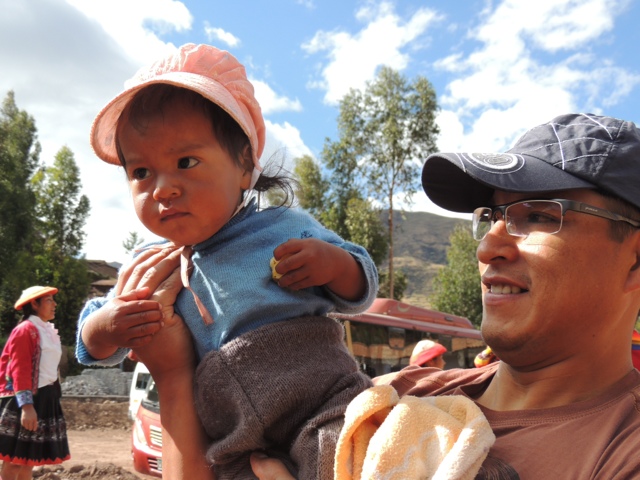
Sweet Eddy and a sweet baby

The women did not mind having their pictures taken, they actually encouraged us to do so.

The women who weren't shovelling came running over to us, everyone got a huge hug and most of us were lifted off of our feet...these small women are strong. They always choose one person in the tourist group to dress up in their traditional clothing, and of course it would be our poor sick woman, who had hardly managed to clamber down off of the bus. But, good sport that she is, she donned the apparel and hung out with the locals. I'd love to put her picture here, but she might not appreciate it!


Freshly shorn, possibly getting ready to spit at me.


Various dyes.
We were given a tour of the weaving facility, it was really interesting. We "met" some of the llamas and alpacas, both post and pre shaved, and we were handed bundles of grass to feed them, I was more concerned that one of them might spit at my camera, they all had "that look" in their eyes.

Then we were shown how they spin the hair into wool...I don't think I've worded that correctly, maybe they "card the wool into yarn", but they did magicky things, and hunks of shaven llama turned into soft strands of stuff.

And if that isn't enough magic for one morning, then they took different types of leaves and roots and bugs and plants and mixed them, and boiled them, and lit fires under them so that mystical puffs of smoke swirled through the air, and ground them with mortar & pestle in all kinds of different combinations, and all the colours of the rainbow appeared, no wonder pachamama (Mother Earth) was so revered. And women....the Incas revered women as well.

I was really impressed at all of that. Oh, and the beetle they used to make  vivid red was the "cochinealla" beetle...when I heard that I inadvertently gasped  "Starbucks!" and to my surprise, a lot of heads nodded in agreement. 

Let me quickly explain, a while ago, maybe a year or two, Starbucks added a vegan strawberry smoothie to their menu, and they stressed the vegan part in all their advertisements. Well, long story short (because I blogged this very thing in this very blog last year...it was quite an anti-Starbucks rant) a whistle-blower let everyone know that the red colour in the smoothie was actually the cochinealla beetle...the vegans were eating bugs. Now, the bug part isn't as disgusting as it sounds, this beetle has been used for coloring for years and years...it's FDA approved and not a health risk in the least, everyone knows that almost everything you eat is allowed a certain part of bug parts...it's all just protein anyhow.  The point was...the smoothie wasn't vegan and Starbucks knew it. Another large corporation screwing the public for money. Ground up beetle was cheaper and more economical than genuine strawberry colouring. Anyhow, before I work myself into a starbuckian dither, I'll just say that it was very interesting to see the beetle in its natural form.
Doing magical things with fire and plants.


After the wool is coloured, they the take another type of leaf and grind it into a bowl of warm water and stir it vigorously and it foams up like the best quality shampoo, the yarn is washed and then hung to dry.

then we watched a bit of weaving and knitting and were given free reign to browse the stalls. There was so much stuff, sweaters and scarves and the Peruvian toques with tassels that everyone seems to feel the need to buy (yes, I bought 2 myself and I don't even wear toques) There were ponchos and socks and mitts and all of these items came in a multitude of sizes and colours...something for everyone.

There were blankets large and blankets small, weavings to hang upon your wall, and oh I wanted one and all...even coloured yarn all wrapped in a ball.


Fingers a flyin'

And I used to complain about needing a better mat to stand on at my workplace.

And a brand new babe on her back. No maternity leave here.
 It was very humbling to see these women work, I think a person needs a taste of other peoples lives every now and then in order to reevaluate your own life. I always return from holidays like this with a renewed appreciation for what I have, and I hopefully stop complaining about the little things so much. And if you think these women have it bad...wait until I get to the women who live on the floating islands of Uros.

After purchasing a few items, it was time to hit the curving, bumpy road once more, and head off to the ruins of Pisac.

Saturday, June 01, 2013

"M" is for "May the 6th...still..."

I cant believe I'm still on May 6th. I seem to be having a struggle with this. Sometimes words just flow out of my fingertips, and other times, well, not so much. This seems to be one of the other times.

So, after lunch, we went to a silver factory. Of course, the term 'factory" is all in the interpretation of the word. In my mind, and I'll bet in yours too, "factory" is a huge building with smokestacks and time clocks and parking lots and lunch rooms and lots of employees who stand in one spot and do the same thing over and over and over. In this case however, "factory" can be more defined as a cottage industry.

Silver is very inexpensive in Peru, and its one of "the things" you should seriously look into buying, both as a great souvenir as well as an investment, and not only that, jewellery is easy to pack in your suitcase that is getting smaller and smaller by the day.

This place is one of the better places, good prices, reputable and so on. But, let's be serious, I'm not naive...I know darn well that our guide, Sweet Eddy, gets a kickback from the vendors depending on how much is purchased by his group. It's this way with all tours, be it free meals in a restaurant or rooms in a hotel. That's the way business is run...all over the world. I couldn't care less who gets what for free, but don't pretend that it isn't happening.

But I liked this place, not only was there a great demo on how they made the jewellery, from the melting of the silver to the finished product, there was a sweet courtyard to sit in, free drinks (water and pop) and bathrooms...ummm, the bathrooms were pretty scary, but they were bathrooms nonetheless. Actually, "bathrooms" may be too strong a word, they were quite filthy, no toilet seats or toilet paper, and no paper towel either. As a matter of fact, let me digress for a minute; paper towel is the one thing you just don't see in bathrooms here. There is a communal towel, usually damp and somewhat grubby. I tried to not think of the germs that must be saturated right into these towels, and I cursed myself mightily on the rare occasion when I didn't have mt hand sanitizer with me...which of course results in the frantic waving and flapping of hands to dry them, or using toilet paper, but half the time the toilet paper was also non-existent and you hate to waste your own precious amount of paper just to dry your hands.

I'm not a jewellery wearer and I had no plans on buying anything, but, well, the prices were so good that I couldn't resist just a few little items.

Everything made by hand.


Each door on the bottom housed a different shop. I think the owners maybe lived upstairs.


Just a tiny sample of the finished product.
 One of the doors went into a gold shop, but gold is out of my price range. Sorry kids, no gold in your Christmas presents this year. Or any year.

After all this, we headed back towards the Plaza de Armas, the city centre, and then out for dinner. Luckily, I wasn't alone. Cusco is not that big, and laid out in quite a nice grid, but I don't know...something about my inner sense of direction....


The main Plaza


Also in the mail Plaza


And also in the main plaza
 Every plaza in every city and town has a cathedral or two, or more, in the center. Is it any wonder I was constantly getting lost? Half the time I thought two different cathedrals were the same one, and they weren't, half the time I thought I was seeing the back of a cathedral that I had just seen the front of, and I wasn't and half the time i was thinking I was in a whole different city. And sometimes I was.

I was more than content to follow along, like one of the sheeple. When I did go out on my own,I was very cautious to make sure I turned around to see from whence I had come. And get this, the one place that I spent most of my time alone and never got lost, was Lima, at night, a city of 10 million people. Go figure.


A fun restaurant, excellent food.


Alpaca fillet, with a Peruvian mash and pepper sauce.
 Back to the Prisma hotel for another good sleep, and tomorrow....what a hike we'll have...some say it's a test that the porters watch you take to see if they think you can mange the Inca Trail.  And I've heard trekkers say that it's harder than the trail, but obviously easier in the sense that it's a two hour hike, not a full day. But it made me realize that I chose the right vacation.